Fluctuating Skills (AA23)

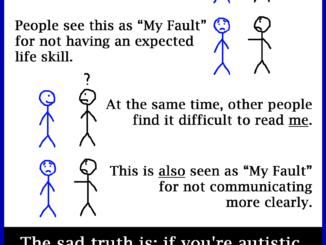
Many neurodivergent people (not just Autistic people, but including Autistic people) have skills that fluctuate from day to day. This comes up so often in IEP meetings that I’m sitting in. People will say of the child in their class, or of the child that they’re the parent of: “I know he knows how to … Read more

When Should I Tell…? (AA23)

I get long-winded. You’ve been reading my posts this month; you know this. 😉 This one, shockingly, doesn’t require me to be long-winded at all. When should parents tell their kids they’re Autistic? -Is the parent able to speak about it with an emphasis on the neutral and positive? (i.e., have they had time to … Read more

Special Interests (AA23)

If I say “imagine a historical figure who was known for struggling with socializing, possibly even considered a ‘failure’ by mainstream criteria such as schooling, yet was intensely successful in one particular area”, you might think of various great inventors, writers, scientists, mathematicians… While it’s dangerous to retroactively try to diagnose people with autism, especially … Read more

Co-Occurring Conditions (AA23)

Autism and ADHD. Autism and OCD. Autism and anxiety. Autism and Tourette’s. Autism and trauma. Autism (as a diagnosis) very commonly accompanies other diagnoses as well, which typically fall into different categories: some of them are mental health-related, some of them are physical (especially gut/digestion, vision/hearing, joint, or coordination related), and some of them are … Read more

Gender & Autism (AA23)

Continuing discussion of Autistic intersectionality… In studies examining the relationship between two things, it’s important to understand the directionality of the relationship. Just because all A are B, doesn’t mean that all B are A. That being said, there *is* actually a correlation in both directions when it comes to autism and gender diversity: people … Read more

Race & Autism (AA23)

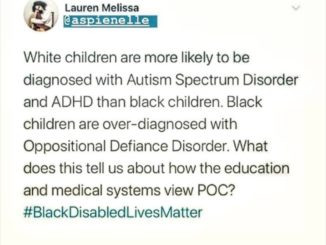
Autism does not just affect white boys. But historically, the diagnostic criteria has been focused around how it presents in white children (especially boys — but that will be the topic tomorrow). Some good news is that recently, and looking at trends over the years, this seems to be changing. For the first time in … Read more

Intersectionality: A Definition (AA23)

I mentioned “intersectionality” briefly a few days ago when I was describing disability, and I think many people have some understanding of what it means: two factors converging — like race and gender, or gender and class — to make factors for the individual that are more difficult than either of them would have been … Read more

Autism Shouldn’t Equal Trauma (AA23)

This is going to be very long. And this was the hardest post to write this month. I sat down to write it three or four times before I was actually able to make myself do so. I’m going to do my absolute best to write it with grace and empathy; I hope you will … Read more

Interoception (AA23)

Interoception may not even be a word you’ve ever heard before, let alone know what it means. At its most basic, interoception is “inner body sense”. On top of the five senses that we all know and learned about, there are other senses as well. Interoception is the one that, for example, can tell you … Read more

Quick Facts about “Asperger’s” (AA23)

Remember that I had a post a few days ago about classifications of autism — i.e., “mild” vs “severe”, or “high functioning” vs “low functioning”. Well, for some people, Asperger’s goes into those types of categories. Some quick facts about Asperger’s: -It’s usually utilized as a quick shorthand for “mild autism”. -It’s sometimes even utilized … Read more