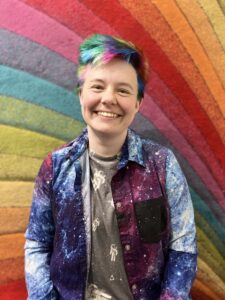
 Kelsie “Mick” Olds (they/she) believes that children deserve to be met in the world where they learn best: play. Their work centers on the conviction that agency, curiosity, and connection rather than strict compliance drives meaningful growth. Whether they’re supporting traumatized kids, autistic teens, PDAers, or gender-diverse youth, Mick’s practice is rooted in respect, creativity, and the understanding that kids are magic.
Mick is a senior paediatric occupational therapist, author, and international speaker. They have presented at the inaugural PDA Conference in Perth, the NeuroNurture Conference, Yellow Ladybugs, and the Australian Conference on Neurodevelopmental Disorders, and they regularly train educators, clinicians, and families around the globe.
Mick holds a Master’s in Occupational Therapy from OU-Tulsa and a Bachelor’s in Psychology from Oral Roberts University. Their career began in rural Oklahoma, where juggling multiple PRN roles gave them rapid exposure to pediatric clinics, schools, foster care group homes, aged care, and hand rehabilitation. Those early years cemented their belief that therapy must adapt to the child, not the other way around.
During the pandemic, Mick began writing and recording resources for families who couldn’t access therapy and this planted the seeds for The Occuplaytional Therapist. A subsequent move to England led to nearly four years serving children of U.S. military families on an Air Force Base, where they refined their play-based approach and began building an online community.
Now based in Geelong, Australia, Mick works as a senior paediatric occupational therapist, travels internationally to speak and train, and continues developing accessible resources through The Occuplaytional Therapist, such as Here to Play and Big Talks, Little Talks.
Mick is drawn to families navigating both simple challenges and overlapping layers of complication. Their work can help people who just need support with one basic thing, but they especially love working with the beautifully complex cases where families won’t find one right answer with just one click. They love figuring out where the theory and the underlying “how do we problem solve” can come together.
Want to learn more about Mick’s approach? Check out this interview with Mick in their own words.