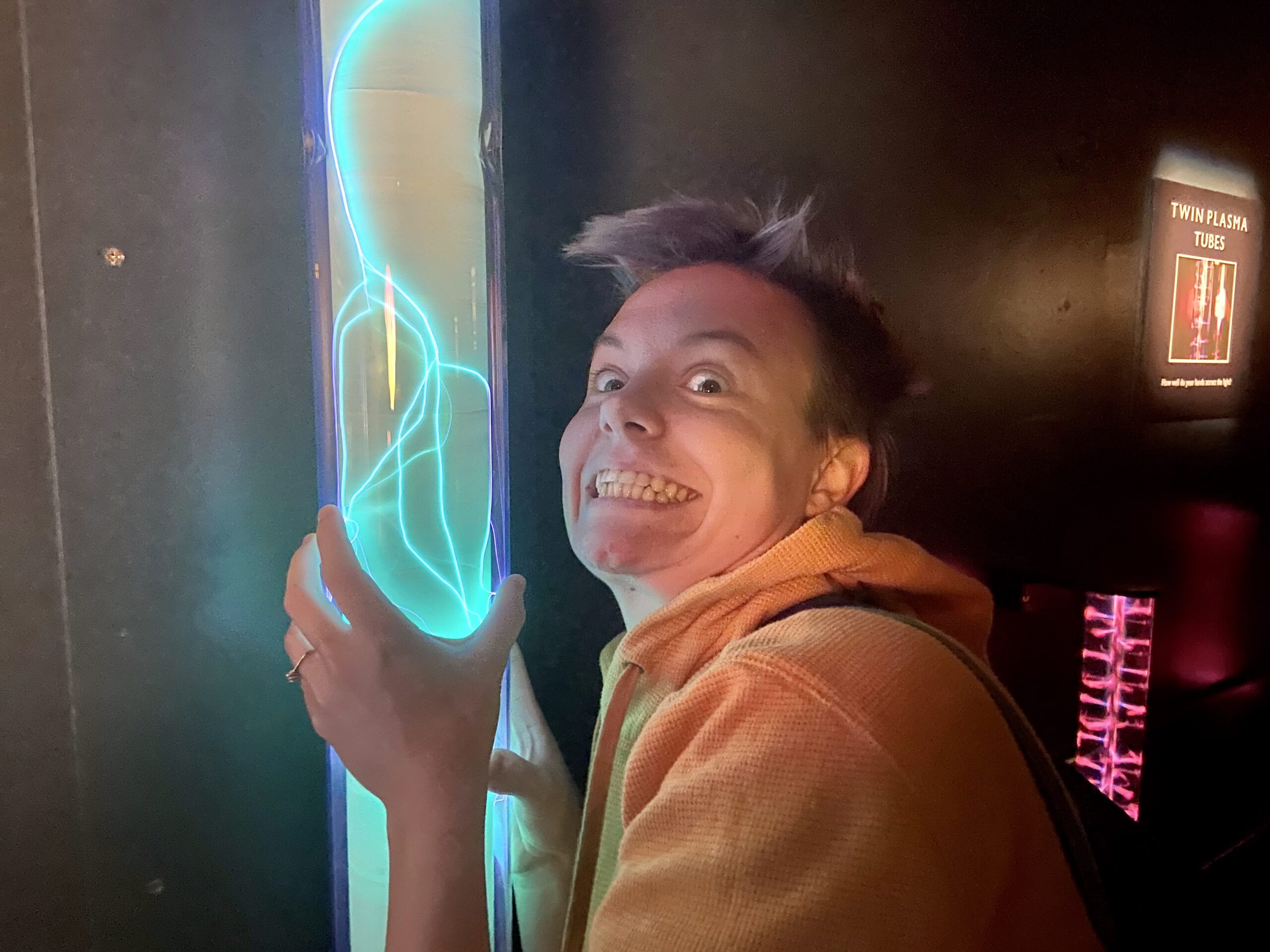
In Toy Story 5, there’s a part where Jessie says, “That’s not playing, that’s just a game!”, referring to a game that she was greatly enjoying involving jumping around and stomping her feet on buttons as they lit up.
When this is met with confusion by another toy, she demonstrates: what she means by “playing” is actually, specifically, “imaginary play with toys”.
(No other spoilers than that for Toy Story 5, that’s just an idea that I thought would be interesting to talk about here.)
An equivalent for what Jessie was doing would be sort of like Dance Dance Revolution or another game like that. A high-energy, enthusiastic, enjoyable game of responding to a triggering sensory stimulus (like a light lighting up) with an action (like stepping in the right area).
And what Jessie considers to be “play” is what Bob Hughes would categorise from his 16 play categories as a blend of four things: imaginative play, fantasy play, role play, and socio-dramatic play.
Is she actually right?
I find the process of defining the word “play” to be really interesting. It’s something that’s come up in several different lectures that I’ve written before: my super-comprehensive training for OTs who want to practice in play-based ways, called “Here to Play”, and then iterations of it in several other lectures as well.
There are play theorists in the world who think like Jessie does. They would consider play with toys to be “real” play, and other actions that are colloquially called “playing” to actually be something else.
Some of the earliest play theorists thought more like this. Jean Piaget in 1962, for example, thought there were really three stages of play that children usually moved through. First, their play was all sensorimotor — just moving your body, feeling with your senses, etc. Then, their play was all symbolic. This would be “pretend play” — the type of thing Jessie is thinking of, where you use toys to act out stories or props to imagine that you’re someone you’re not. Lastly would be games with rules, like sports or other more structured types of play, and then, once you were no longer a child, Piaget saw people as no longer playing. If an adult engaged in a sport, they would be doing it for another reason, not authentically playing.
Vygotsky was another theorist around this time, in 1966, who had similar, though distinct, views on play. He really only saw pretend play as valid play whatsoever. The sensorimotor things that children do, which Piaget called play, Vygotsky did not think was real play. They might be having fun, but they weren’t truly playing. And furthermore, when kids grew up a little and started following more structured rules, he saw that as not real play either. For Vygotsky, only the pretend play was “real” play.
So maybe Jessie was reading Vygotsky? She was from the 1950s or 60s, so who knows. 😉
I already mentioned Bob Hughes, whose work I really admire. He describes sixteen different play types that cover the whole range of childhood and a much wider swath than Jessie or Vygotsky allow for! For Bob Hughes, moving your body in a delightful way absolutely counts as a form of play. So does sitting still and telling jokes to one another. So does seeing how many crayons you can hold in your hand all at once, or seeing what happens when you try to stick a crayon into the wall outlet. So does squabbling with your friend about what you want to play and coming up with new ideas for 15 minutes and then finally deciding and then only “playing it” for 10 seconds before going and getting a new idea. Bob Hughes’ definition of play is a lot more like mine. I see play as broad and expansive and love the way that it can describe different stages of development and learning that different children are going through.
Outside of the realm of humans, there is also study of play by biologists who study play in different types of animals! You might be able to think of what a puppy looks like playing, or a dolphin. Another researcher whose work I really love is Gordon Burghardt. He studies play in animals that are not at all typically thought of as playing, like insects, reptiles, and amphibians!
You might ask yourself, what on earth would play look like in an insect? Burghardt defines play as following these five criteria. An animal who’s engaging in any action that: (1) Is not required for survival, (2) happens voluntarily or intentionally and is its own reward, (3) is awkward, exaggerated, or precocious (like a child animal acting out an example of something an adult animal does, but in kind of a childish way), (4) takes place during the immature stages of that animal’s life cycle, and (5) happens when the animal isn’t under stress. If you think these through from the point of view of a child human, they do sound an awful lot like play (with the exception that human children often DO play out whatever it is that’s stressing them out as they try to process it).
Then there’s my most favourite definition of play of all, which comes from Teacher Tom, or, more accurately, from a 4 year old in his preschool program, who informed him that “Play is what I do when people aren’t telling me what to do.”
I think this encompasses the way that children actually play. It stretches out, it covers everything in their entire life, it reflects how, if left to their own devices, they naturally begin playing. It underscores how powerful autonomy is for children and why play is the sphere that they lean into for that autonomy. It’s absolutely perfect and it’s in just a few words.
I also think that it explains why Jessie didn’t see a dancing game as being “real play”. In a way, for Jessie, she perceived the game having different flashing lights she had to step on as being “something telling her what to do”. Even though she was enjoying herself and participating in it enthusiastically, it wasn’t what she would’ve done if she’d had her choice, because her choice is always to engage in imaginary play with the child she loves and the other toys that they have.
But real-life kids aren’t toy dolls, and don’t have to engage in pretend play for it to count as valid “play”! There are many kids who loooooove imaginary play and there are also kids for whom that type of play just does not resonate. And they aren’t “not playing” just because they’re playing a different way.