In Their Own Words: An Interview with Mick
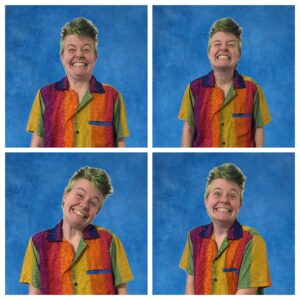
We sat down with Mick to learn more about their journey into occupational therapy, what drives their work, and how their approach has evolved over the years.
What made you realize occupational therapy was what you wanted to do?
When I was 13, some family friends adopted a baby girl with Down syndrome from overseas. They had a blog about the process, and I was relatively new to using the Internet at home and for fun and by myself. I followed the process with great interest.
Up until that point, I had suspected I would end up in some sort of creative, artsy career, or work with children in some capacity. Their process of adopting, and subsequent process of finding their daughter the supports she needed, sparked a love in me for adoption and also for occupational therapy.
(Turns out “work with children” + “creative, artsy” combine really well.)
Before that, I had a laundry list of answers to the question “what do you want to be when you grow up”. But after that, after finding out about OT, I was sold. I knew this was the one for me.
 What do you love most about your work?
When a kid completely takes the reins in a session and it goes in some wild unexpected perfect way. I know that I’m never going to be able to write the right words to capture the magic of a moment like that. I delight in trying. People delight in reading my best attempts at doing so and yet I still know that even then, I still didn’t get the depths of how great it was. Kids are magic.
How has your focus evolved over the years?
Interestingly, I feel like my own priorities or area of interest changes almost year by year; I can often trace a specific trend to a certain year in my practice. It’s not like I choose a theme and then set out to do that that year, it’s only something I can notice clearly in retrospect.
- 2019: Traumatized kids need more agency; compliance doesn’t work
- 2020: How to create resources that can be shared over distance
- 2021: Wait maybe compliance doesn’t work for all kids
- 2022: How to document/justify to insurance or skeptical grownups what I intuitively know is true, that kids need to play
- 2023: Big kids play too, not just little kids
- 2024: How to tell kids about their own brains
- 2025: The marginalized of the marginalized – supporting PDA kids and trans kids especially
What kinds of families do you find yourself drawn to?
I find myself drawn to families with complex situations where lots of things are going on, perhaps because it’s so much like my own home life. I feel like my work can be super helpful to people who just need support with one basic thing (“aah, my kid keeps spitting and it’s gross!”) because it’s easy to help with one basic thing from an online platform. But I also really like working with the people who have 27 overlapping layers of complication. It means that they’re not going to find One Right Answer easily on my site, but I think that the theory and the underlying “how do we problem solve” goes a long way in helping them problem solve for their very specific complicated situation.
I also love trans and gender diverse kids a lot. It’s a specialty I unintentionally stumbled into.